The Static Posture Trap: Why Your Ergonomic Setup Fails Your Neck
The 'perfect' ergonomic posture everyone recommends is actually making your neck weaker by training your muscles to hold a single, static position for hours. The entire ergonomic furniture industry is built on the idea of finding a single, neutral position to prevent strain. This approach is fundamentally flawed. It ignores the fact that the human body is designed for movement, not for being frozen in one supposedly ideal shape.
The Flaw in 'Perfect' Ergonomic Posture
The conventional wisdom says to arrange your desk for a neutral spine: monitor at eye level, elbows at 90 degrees, feet flat on the floor. But here's the part nobody talks about: holding this position reduces the constant micro-adjustments that keep your deep cervical stabilizer muscles engaged. Without that dynamic demand, these crucial muscles begin to weaken, a process known as disuse atrophy.
Furthermore, this constant static load restricts blood flow. According to the Canadian Centre for Occupational Health and Safety, prolonged static postures are a primary hazard because they reduce circulation and accelerate muscle fatigue (CCOHS). This leads to the buildup of stiffness and metabolic waste in the muscle tissue long before you consciously register pain. Your expensive ergonomic chair isn't preventing strain; it's just enabling a more comfortable path toward muscle weakness and chronic tension.
Shifting from Static Holds to Active Recovery

Photo by Yan Krukau on Pexels
True neck resilience comes from dynamic strength and active recovery, not from attempting to immobilize your head and shoulders. The goal should not be to eliminate all load, but to manage it intelligently. This means integrating movement throughout the day and using tools that actively counteract the effects of unavoidable static periods.
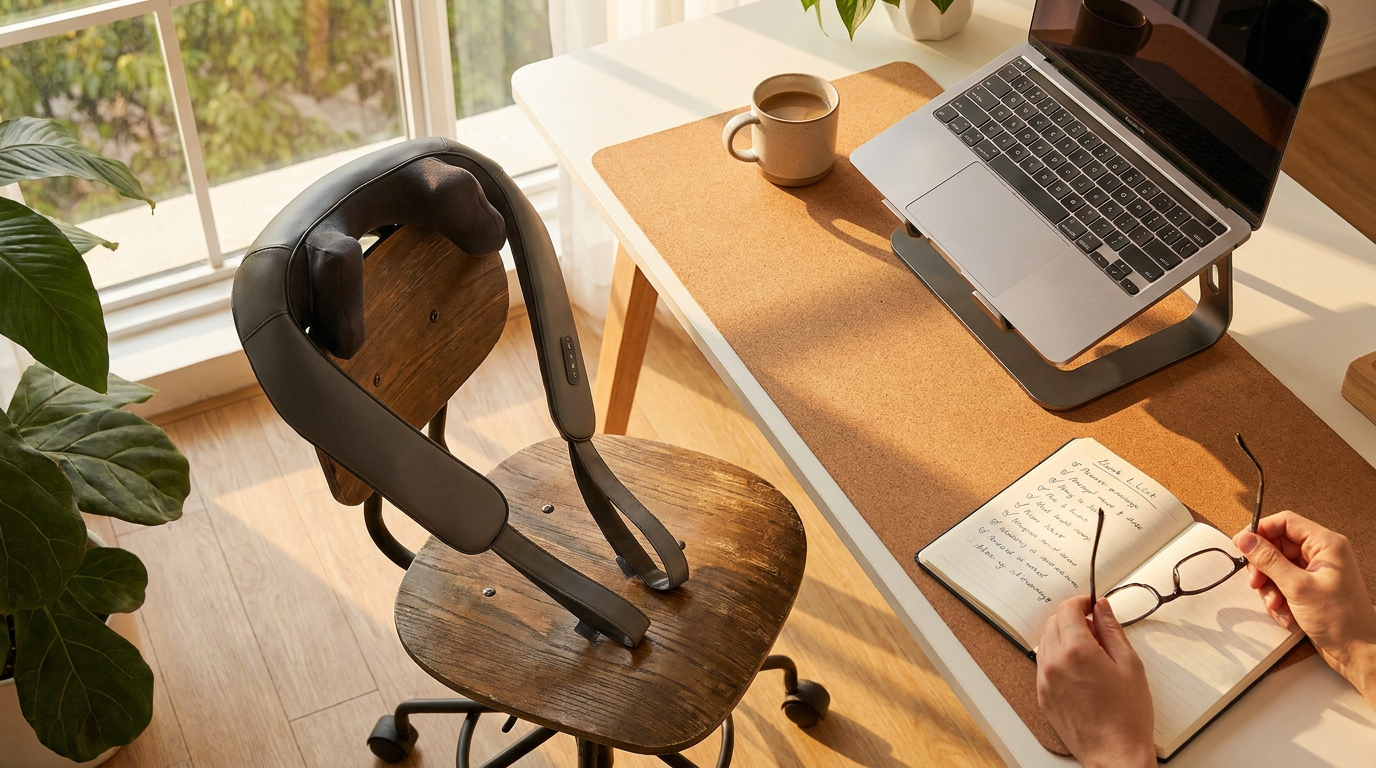
A Cordless Neck Massager fits into this model not as a crutch, but as an active recovery device. By using TENS or shiatsu technology to stimulate muscle tissue, it helps restore the blood flow that static posture restricts. This intervention is critical for flushing out metabolic byproducts and delivering oxygen to fatigued muscles. Understanding what makes a Cordless Neck Massager effective is less about comfort and more about its function in a dynamic health protocol. For instance, optimizing recovery with a rechargeable neck massager that includes heat can further enhance circulation to the fascia and deeper muscle layers, directly addressing the stiffness caused by static loads.
Is there a 'perfect' posture for desk work?
No. The belief in a single 'perfect' posture is the core of the problem. A better strategy is to cycle through several 'good enough' positions and to stand up and move every 20-30 minutes. The most important ergonomic adjustment is not your monitor height, but a timer that reminds you to break your static hold. Your neck gains resilience from movement, not from being locked in place.
How does a neck massager support a dynamic workspace?

Photo by Gustavo Fring on Pexels
It serves as a targeted recovery tool to counteract the physiological effects of static work. While frequent movement is the primary strategy, a 15-minute session with a massager can actively restore circulation and release acute tension in the upper trapezius and cervical extensors. It is not a passive fix for a bad setup; it is an active component of a workday that prioritizes muscular health. Learning how to use a shiatsu neck and shoulder massager correctly ensures the device is used for functional recovery, not just temporary relief.
I'll change my mind when ergonomic guidelines prioritize scheduled micro-movements and active recovery metrics over diagrams of a single, static 'neutral' posture.