Static Posture: The Real Reason You Can't Fix Tech Neck at Your Desk
The obsessive focus on ergonomic perfection is a misdirection; the real enemy of your neck is static posture, not just bad posture. The conventional wisdom says raising your monitor and performing chin tucks will resolve the forward head carriage common in desk workers. This advice ignores the physiological damage of stillness itself. Holding your 10-pound head in any single position for hours creates a state of constant isometric tension, which is the true source of the problem.
The Flaw in the 'Perfect Posture' Argument
Even with a monitor at eye level and a spine in perfect alignment, your trapezius and levator scapulae muscles are forced into a continuous, low-level contraction to keep your head upright. This static hold severely restricts blood flow, preventing oxygen from reaching the muscle tissue and metabolic waste from being cleared.
Run the math: an eight-hour workday, five days a week, amounts to 40 hours of sustained isometric load on the cervical spine and supporting musculature. Over time, this leads to muscle fatigue, stiffness, and the formation of painful trigger points. An ergonomic chair doesn't change this reality; it just makes you comfortable while the damage accumulates. The goal isn't to find a perfect static position, but to break the cycle of stillness. Evaluating tools for this purpose requires looking beyond simple comfort, comparing the value of different massagers based on their ability to provide this interruption.
Why Desk Stretches Aren't a Long-Term Fix

Photo by tommy picone on Pexels
Stretching a tight neck provides momentary relief because it temporarily elongates the muscle fibers. However, it fails to address the underlying cause: the deep muscle adhesions and poor circulation from hours of static tension. As soon as you return to your desk, the isometric hold resumes, and the pain returns.
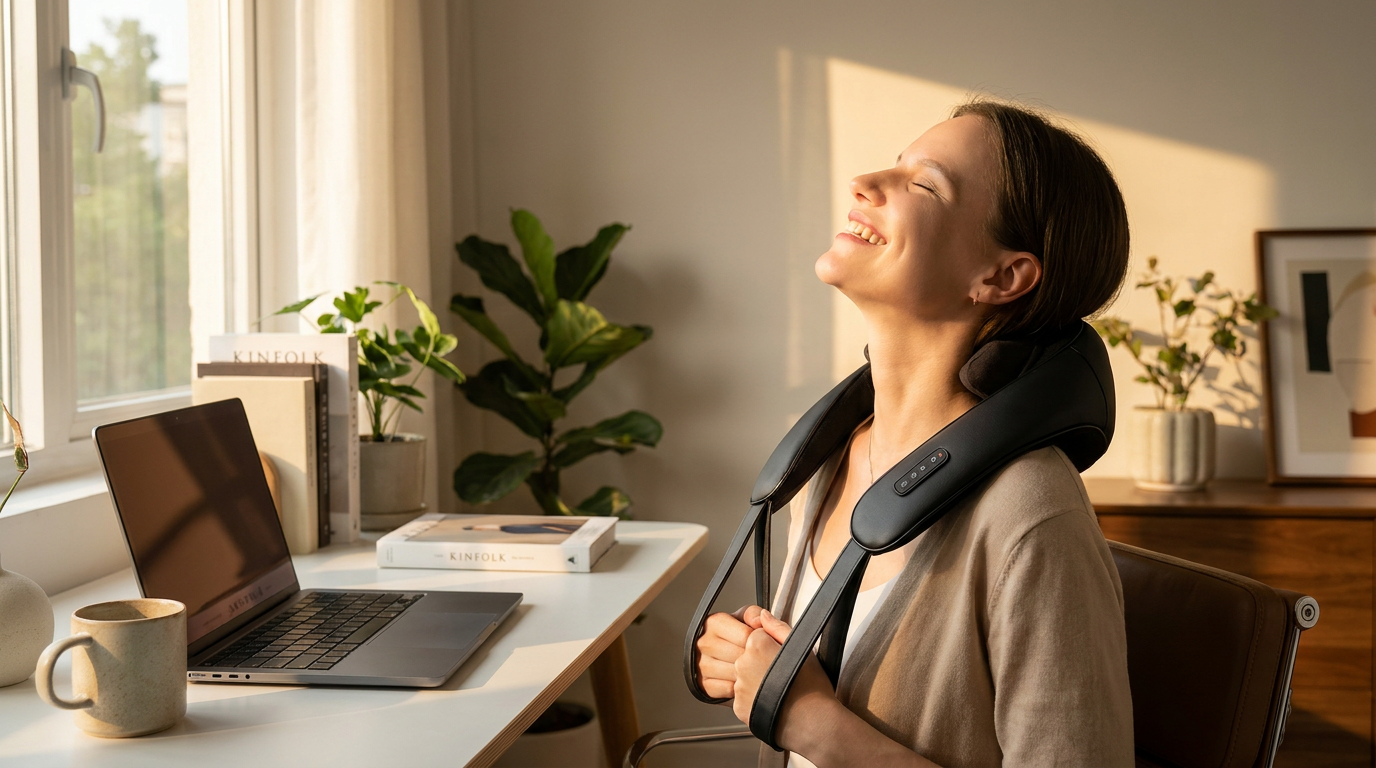
Here's the part nobody talks about: to create lasting change, you must reintroduce circulation and mechanically break up the knots that stretching can't reach. This requires targeted, percussive, or kneading pressure. A Cordless Neck Massager provides this mechanical release without requiring you to stop working. It physically manipulates the tissue, forcing blood back into the starved muscles and breaking the adhesion cycle. This function is more critical than any other neck massager spec that buyers often focus on. I'll change my mind when a stretching regimen alone is proven to counteract 2,000 hours of annual static load. Until then, the evidence points to the necessity of direct mechanical intervention, a principle demonstrated in field tests of effective shiatsu devices.
How does static posture damage neck muscles?
When a muscle is held in a fixed position, it's in an isometric contraction. Unlike dynamic movements (like lifting and lowering a weight), this static state significantly reduces blood flow. According to the American Council on Exercise, this lack of circulation prevents oxygen delivery and waste removal, leading to muscle fatigue, pain, and the formation of hardened knots or trigger points over time.
Is a neck massager better than stretching for tech neck?

Photo by tommy picone on Pexels
A neck massager and stretching serve different functions. Stretching provides temporary elongation for tight muscles. A massager, however, provides mechanical force to break up deep adhesions and restore circulation that has been cut off by prolonged static posture. For desk workers, using a Cordless Neck Massager for 10-15 minute intervals is a more direct countermeasure to the physiological effects of static holds than stretching alone.