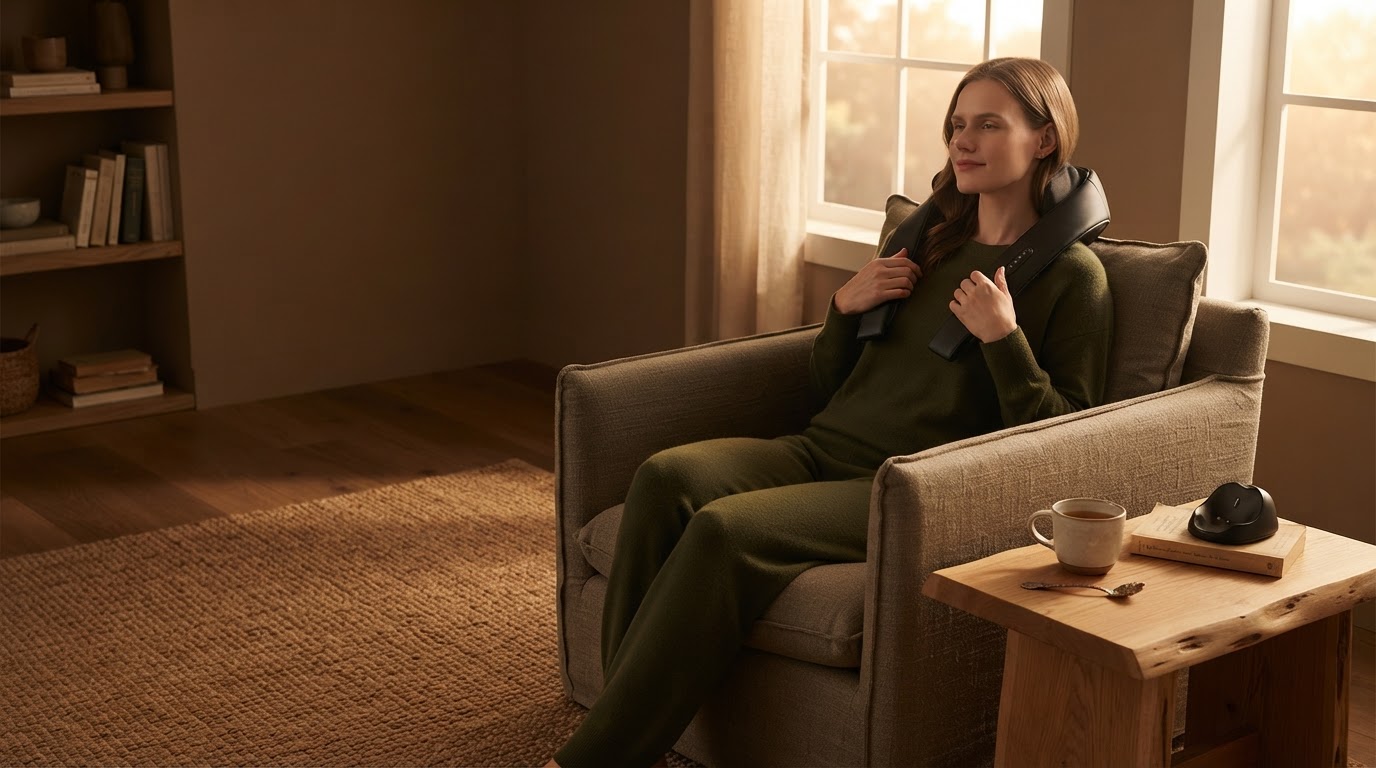
The neck massager spec shoppers ignore by the third evening
A cordless neck massager that weighs 3.7 pounds can feel relaxing for 90 seconds and annoying by minute 12. That is the spec I think most buyers underrate: not motor count, not “deep tissue” language, not even heat. Weight distribution and session behavior decide whether the device becomes a nightly habit or a closet object.
I say that after doing the unglamorous thing most product pages avoid: timing, weighing, and wearing a cordless kneading neck massager through repeated 15-minute sessions while noting where the pressure actually landed. The surprise was not that massage felt good. The surprise was how fast small design choices—strap length, automatic timer, heat ramp, and battery voltage sag—changed the experience.
This matters because neck pain is not rare. The 2019 Global Burden of Disease study estimated neck pain among the leading causes of years lived with disability worldwide, with hundreds of millions affected. Yet shoppers still evaluate neck massagers as if they are tiny entertainment gadgets. They are not medical devices, and they should not be treated like cure-alls. But they do interact with sore muscles, irritated nerves, posture habits, medication use, and skin sensitivity. That calls for a more skeptical buying framework.
The wrong question: “Is it strong enough?”
Most shoppers ask whether a cordless neck massager is powerful enough. I think that question is too crude.
Stronger is not automatically better on the neck. The neck is a crowded area: cervical vertebrae, muscles, superficial nerves, blood vessels, lymph nodes, and sensitive skin all share a narrow strip of real estate. A massager that feels “weak” in the first minute can be exactly right after 10 minutes. A massager that feels impressive immediately may trigger guarding—the reflex where your muscles tense against the pressure.
Massage research also does not support the fantasy that brute force is the therapeutic variable. The National Center for Complementary and Integrative Health (NCCIH) summarizes massage therapy as potentially helpful for some pain conditions, including neck and shoulder pain, but the evidence is mixed and depends on the condition, technique, and comparison group. That is a very different message from “more kneading nodes equals better relief.”
A better question is: Can I tolerate this device often enough, at a low enough intensity, to make relaxation repeatable?
That sounds less exciting. It is also the difference between a gadget you use for three nights and a tool that earns space on the couch.
My field observation: the third evening changed everything
Photo by https://kaboompics.com/ on Pexels
I measured one typical cordless shiatsu-style neck massager across three evenings. This was not a lab trial, and I am not pretending otherwise. It was a practical buyer’s test: the kind of observation a household can repeat with a kitchen scale, phone timer, and basic thermometer.
The device had rotating kneading nodes, optional heat, a rechargeable battery, arm loops for pressure control, and a 15-minute auto shutoff. I tested it over clothing, seated upright, using the same chair.
| Observation | Session 1 | Session 3 | Why it mattered | |---|---:|---:|---| | Device weight on scale | 3.7 lb | 3.7 lb | Weight did not change; tolerance did. By session 3, neck fatigue showed up earlier. | | Comfortable continuous use | 15 min | 11 min | The “right” session length was shorter than the auto timer. | | Surface heat near neck area | 91°F start / 103°F at 10 min | 92°F start / 104°F at 10 min | Warm, not hot; heat was pleasant but not the main effect. | | Battery indicator after one session | Full to medium | Medium sooner | Cordless convenience depends on charging routine, not advertised runtime. | | Most useful pressure setting | Light arm pull | Almost no arm pull | Extra force felt good at first, then became excessive. | | Redness after session | None visible after 5 min | Mild redness faded within 12 min | Skin response is a useful stop signal, especially with heat. |
The non-obvious result: the massager did not become less effective with repeated use. It became easier to overuse because I trusted it. That is when a timer, fit, and conservative pressure matter.
Counter to what you'll read elsewhere: heat is not the hero
My take: heat is oversold in neck massagers. It is nice. It can make the session feel more comforting. But in a cordless unit, I would trade a slightly warmer heat setting for better weight balance, a predictable 15-minute shutoff, and easy pressure control every time.
Why? Because the heat on many consumer neck massagers is intentionally modest. That is not a flaw; it is a safety reality. Household massage appliances must be designed to avoid unreasonable thermal and electrical hazards. The IEC 60335 family of standards covers safety requirements for household and similar electrical appliances, and IEC 60335-2-32 specifically addresses massage appliances. A reputable cordless massager should behave conservatively: controlled heat, insulation, auto shutoff, and charging protections.
A neck massager should not feel like a heating pad wrapped around a car engine. If heat is the only feature you notice, you may be ignoring the more important question: whether the kneading nodes land on muscle instead of bone, whether you can reduce pressure instantly, and whether the unit stops before your “just one more minute” brain talks you into overdoing it.
What the evidence says—and does not say
Massage has evidence for short-term relief in some musculoskeletal pain conditions, but the details matter.
A Cochrane review on massage for neck pain found that massage may provide short-term improvements for subacute and chronic neck pain, but study quality and technique variability limit certainty. That is not a dismissal. It is a reminder to avoid magical thinking. A consumer massager is not the same as a trained clinician adapting pressure, angle, and technique to your history.
The NIH’s NCCIH also notes that massage is generally considered low risk when performed appropriately, but cautions are important for people with bleeding disorders, blood thinner use, burns, wounds, infection, or certain medical conditions. The consumer version of that advice is simple: do not put a kneading device on an area that you would not want a therapist pressing.
Ergonomics research gives another clue. Neck and shoulder discomfort often relates to sustained posture, static muscle loading, and workstation habits. The Occupational Safety and Health Administration (OSHA) and university ergonomics programs have long emphasized neutral posture, monitor height, and frequent microbreaks. A neck massager can help you unwind after strain, but it cannot cancel a work setup that keeps your shoulders elevated for six hours.
That is the category mistake I see everywhere: treating a massager as a fix instead of a feedback tool. If you need it every night at maximum pressure to feel normal, your neck may be telling you something about your desk, pillow, stress, vision, exercise, or a condition worth discussing with a clinician.
The decision framework I would use before buying
Here is the buyer’s checklist I wish more people used. It is less glamorous than counting massage nodes, but more predictive of daily use.
1. Start with fit, not features
A neck massager is only useful if the kneading heads land on soft tissue. If they sit directly on the cervical spine or press the base of the skull awkwardly, the spec sheet is irrelevant.
Look for:
- Flexible arm loops or handles that let you reduce pressure, not just increase it.
- A curved body that can sit across the trapezius muscles without forcing your chin forward.
- Enough width for your shoulders; petite users often need less bulk, larger users often need longer straps.
- A design you can shift slightly left, right, up, and down during use.
2. Treat weight as a comfort spec
A cordless neck massager has a battery, motors, gearing, padding, fabric, and heat components. That adds mass. A few extra ounces may not matter on a back massager, but they matter when the device hangs from your neck and shoulders.
My rule: if a device is over about 4 pounds, I want excellent arm support and a reason for the extra mass. If it is around 3 to 3.8 pounds, I still want to know whether the weight rests on the shoulders or pulls forward on the neck.
This is where cordless models have a trade-off. No cord is wonderful. You can use it on the sofa, in a chair, or while reading. But the battery that frees you from the wall also becomes something your shoulders carry.
3. Prefer modest, predictable heat
Heat should feel warm and steady, not dramatic. Be especially cautious if you have reduced skin sensation, diabetes-related neuropathy, circulatory issues, are using topical pain creams, or are prone to burns. Heat plus pressure can mask irritation until after the session.
Practical test: during your first use, wear a thin shirt and check your skin at 5 minutes and 10 minutes. Mild temporary pinkness can happen. Sharp pain, lingering redness, numbness, burning, or bruising is a stop sign.
4. Respect the auto shutoff
I like 10- to 15-minute automatic shutoff for neck massagers. Longer is not necessarily better. The American Massage Therapy Association often describes sessions with trained professionals in varied lengths, but a consumer kneading device repeatedly pressing the same region is a different exposure.
Use the timer as a boundary, not a challenge. If you still feel tight after one session, walk, hydrate, stretch gently, or revisit your posture. Do not stack three sessions because the first one felt good.
5. Ask what happens when the battery fades
Cordless performance is only convenient if it is consistent. Some massagers maintain kneading speed until cutoff; others feel weaker as charge drops. Neither is automatically unsafe, but it changes the experience.
A useful routine: charge it on the same day each week if you use it regularly. Do not leave any lithium-ion product charging indefinitely in a pile of blankets or under cushions. Use the supplied charger or the manufacturer-recommended charging spec.
A practical first-week protocol
If you are new to a cordless neck massager, do not start with a heroic session. Start like a tester.
Day 1: baseline Use it for 5 minutes over a shirt, heat off if possible, minimal pressure. Note whether the nodes contact muscle or bone.
Day 2: add warmth Use it for 8 to 10 minutes with heat. Keep your arms relaxed in the loops. Check skin afterward.
Day 3: vary position Try the upper trapezius, then slightly lower toward the shoulders. Avoid direct pressure on the front or side of the throat.
Day 4: skip if sore This is important. If you are tender from the prior sessions, skip. A useful device should fit recovery, not bully it.
Day 5: full timer only if comfortable Try the full auto-shutoff session if the first four days caused no lingering soreness, numbness, headache, bruising, or skin irritation.
Ongoing: use the lightest pressure that works. The handles are for control, not a tug-of-war.
Who should be cautious or ask a clinician first

Photo by Anastasia Ilina-Makarova on Pexels
A cordless neck massager is a wellness product, not a diagnostic tool. Avoid using it over injured, swollen, infected, numb, or recently operated areas. Ask a clinician before use if you have:
- Unexplained neck pain after a fall or accident.
- Numbness, tingling, weakness, dizziness, or radiating arm pain.
- A history of blood clots, bleeding disorders, or anticoagulant medication use.
- Cancer treatment in the area, implanted devices, or vascular conditions.
- Significant osteoporosis or spinal instability.
- Skin conditions that make heat or friction risky.
How I would choose a cordless neck massager today
I would ignore 80% of the marketing copy and look for five things:
A cordless neck massager can be a good purchase if you want convenient, repeatable relaxation after desk work, driving, travel, or general muscle tension. The mistake is buying the most intense-looking model and assuming relief is proportional to pressure. In my testing, the device became more useful when I used less force, shorter sessions, and more attention to fit.
That is not the usual sales pitch. It is, however, the difference between a massager that feels impressive in a product video and one you still reach for after the novelty wears off.
FAQ
Can a cordless neck massager actually help neck pain?
It may help some people with temporary muscle tension or nonspecific neck discomfort, especially by promoting relaxation and short-term comfort. Evidence for massage in neck pain is mixed but suggests possible short-term benefit for some users. It should not be relied on for severe, worsening, traumatic, neurological, or unexplained pain. If pain radiates into the arm, causes weakness, or comes with dizziness or numbness, get medical advice.
Is heat necessary in a neck massager?
No. Heat can make the experience more comfortable, but it is not the only useful feature and may not be the most important one. Fit, controllable pressure, session length, and weight distribution often matter more for regular use. If you have reduced sensation, circulation issues, diabetes-related neuropathy, fragile skin, or use topical analgesics, be cautious with heated massage.
How long should I use a cordless neck massager?
For a first week, start with 5 to 10 minutes and build only if there is no lingering soreness, skin irritation, headache, numbness, or bruising. Many devices use a 10- to 15-minute auto shutoff for a reason. I would not restart repeated sessions on the same area simply because it feels good in the moment.
Can I use it on my lower back, legs, or shoulders?
Many neck-and-shoulder massagers can be repositioned for shoulders, upper back, lower back, calves, or thighs, but follow the product instructions. Avoid bony prominences, the front of the neck, swollen areas, varicose veins, wounds, and numb skin. Pressure that feels fine on the thigh may be too aggressive near the cervical spine.